Skip to content

Breast Cancer

BRCA1/2 & panel testing for hereditary breast cancer risk.

Ovarian Cancer

Inherited risk across BRCA and Lynch-related genes.

Prostate Cancer

Germline risk assessment for prostate cancer.

Colorectal Cancer

Lynch syndrome & polyposis hereditary screening.

Pancreatic Cancer

Familial pancreatic cancer gene testing.

Melanoma

Inherited melanoma & skin cancer risk genes.

Endometrial Cancer

Lynch syndrome & inherited womb cancer risk.

BRCA Testing All cancer testing
Prenatal screening tests
NIPT overview KNOVA NIPT Panorama NIPT PrenatalSafe 3UK Panorama Microdeletions PrenatalSafe Complete Plus Niptify Unity Aneuploidy Screen Unity Complete Screen

Not sure which NIPT is right?

Compare accuracy, scope and turnaround, or speak to a genetic counsellor.

NIPT statistics →
Our approach
About Us Location Finder What is Genetics? Genetic Tests Understanding Statistics Polygenic Risk Scores Blog
Consultations & sequencing
Clinical Geneticist Genetic Counselling Whole Genome Sequencing Whole Exome Sequencing Next Generation Sequencing

Carrier Screening

Find out if you carry recessive conditions before pregnancy.

Karyotype

Chromosome analysis for structural & numerical changes.

Genetic Disease Risk Popular

Polygenic risk score across 21 common conditions.

Medication Check Popular

Pharmacogenomics - how your genes affect 112+ medications.

Newborn Genetic Screening

Wider screening than the NHS heel-prick, from a cheek swab.

Polycystic Kidney Disease

Genetic testing for PKD1/PKD2 inherited kidney disease.

Library Fees
  • Mission
    About UsWhat is Genetics?Genetic TestsAdvanced Genetic TestsClinical GeneticistGenetic CounsellingMidwife CounsellingUnderstanding StatisticsWhole Genome SequencingWhole Exome SequencingNext Generation SequencingBlog
  • Cancer
    Breast CancerProstate CancerOvarian CancerColorectal CancerPancreatic CancerEndometrial CancerBRCA TestingMelanoma Skin Cancer
  • Reproductive
    Carrier ScreeningKaryotype
  • NIPT

    NIPT Brand Options

    KNOVA NIPTPrenatalSafe 3UKPrenatalSafe Complete PlusPanorama NIPTPanorama MicrodeletionsNiptifyUnity Aneuploidy ScreenUnity Complete ScreenNIPT StatisticsMidwife Counselling
  • Panels

    NIPT Brand Options

    Polycystic Kidney DiseaseNewborn Genetic Screening
  • Library
  • Fees
Book Now
Testing for >1000 conditions using your DNA

How do polygenic risk scores work?

Think of a polygenic risk score (PRS) like a weather forecast for your health. It estimates your inherited susceptibility to a condition by summing the very small effects of many common DNA variants. A higher chance of rain does not guarantee a downpour, but it might persuade you to take an umbrella. A PRS is not a diagnosis and it is not destiny - it is one risk factor among several, alongside your age, sex, family history and lifestyle.


Talk to a Genetic Counsellor
Trustpilot
Trustpilot
Talk to a Genetic Counsellor
Medically reviewed by Ailidh Watson, Lead Genetic Counsellor·Last reviewed January 2026
Cancer Screening
  • Breast Cancer
  • Prostate Cancer
  • Ovarian Cancer
  • Colorectal Cancer
  • Pancreatic Cancer
  • Endometrial Cancer
  • BRCA Testing
  • Melanoma Skin Cancer
NIPT Screening
  • Basic NIPT
  • PrenatalSafe 3 UK
  • PrenatalSafe Complete Plus
  • Panorama Microdeletions
  • Niptify
  • Panorama Basic
  • Unity Complete Screen
  • Knova NIPT
  • NIPT Statistics
Reproductive
  • Carrier Screening
  • Karyotype
Other
  • What are Genetics?
  • Our Mission
  • Genetic Counselling
  • Understanding Statistics
Panels
  • Polycistic Kindey Disease
Library
Book Now
Menu
WhatsApp
Speak to a Genetic Counsellor Today

What a polygenic risk score actually measures

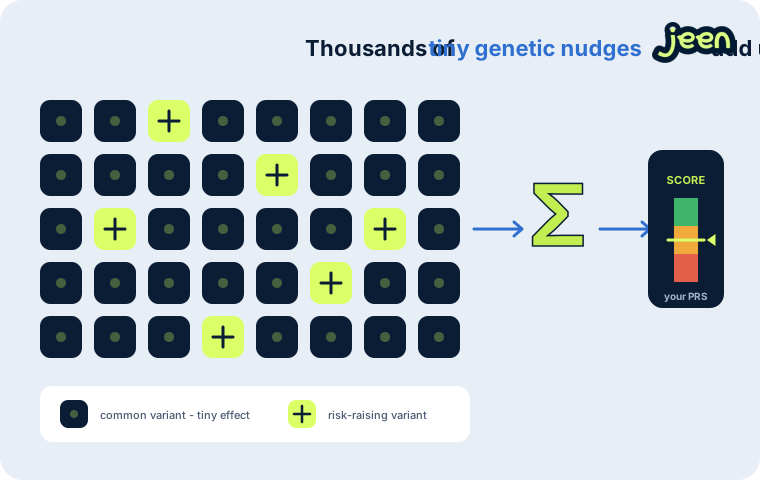
A polygenic risk score is a single number that adds together the effects of many genetic variants - usually SNPs - to estimate your inherited susceptibility to a condition. A SNP is simply a one-letter spelling difference in your DNA at a particular position. On its own, almost every SNP does very little. What makes a PRS useful is that many common conditions are polygenic: the risk is spread across thousands of variants, each casting a tiny "vote". This is very different from a monogenic test such as a BRCA test, which looks for a single rare, high-impact change. One vote never decides the result, but thousands of tiny votes can move the final total.

Illustration of many small DNA variants each adding a tiny vote to a polygenic risk score

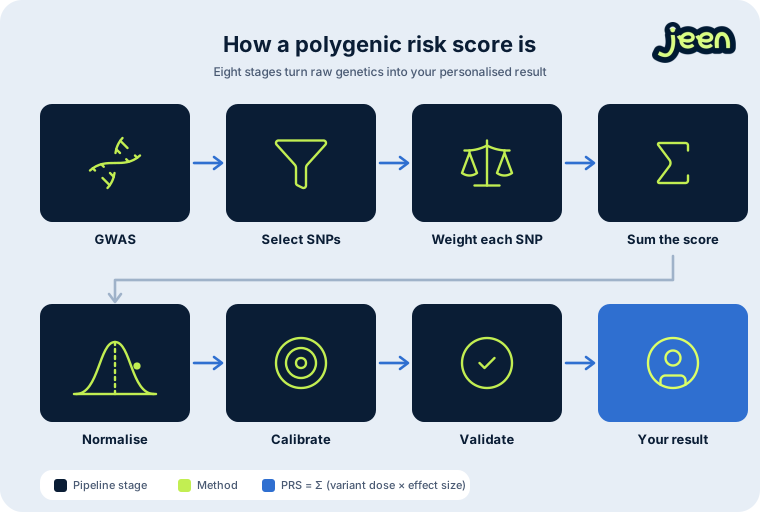
How a polygenic risk score is built

Building a polygenic risk score follows a careful pipeline. It starts with a genome-wide association study (GWAS) and ends with a validated, calibrated score that can be reported back to you. Each step below makes the raw number more trustworthy and easier to interpret. You can see the same logic explained for genetic tests in general on our understanding statistics page, and explore the public PGS Catalog of published scores.

Diagram of how a polygenic risk score is built from a GWAS through weighting, summation, calibration and validation

Start with a GWAS

Finding Variants Linked To Risk

A GWAS compares very large groups of people, with and without a condition, to find which SNPs are associated with it. The output is a table of variants, each with an estimated effect, while age, sex and ancestry are accounted for. The bigger and more diverse the study, the more reliable the foundation for your score.

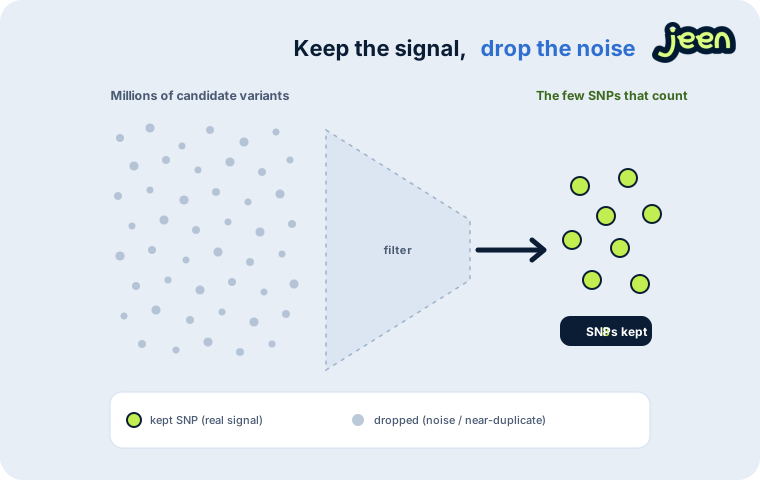
Diagram showing the informative SNPs selected from many candidate variants

Estimate effects and select SNPs

Keeping The Signal, Removing The Noise

Each SNP is given an estimated effect size. Not every variant is kept: some are near-duplicates of one another, so the pipeline either trims them down or uses methods that keep many variants but shrink the noisiest estimates. The aim is to keep genuine signal and avoid being misled by chance.

Diagram of each variant weighted by its effect size and summed into a polygenic risk score

Weight and sum the variants

Adding Up The Tiny Votes

Each chosen SNP is given a weight based on how strongly it is linked to the condition. Your raw score is then the sum of your dosage at each variant multiplied by its weight - in plain terms, PRS = the sum of (dosage x weight). This single number is the mathematical heart of every polygenic risk score.

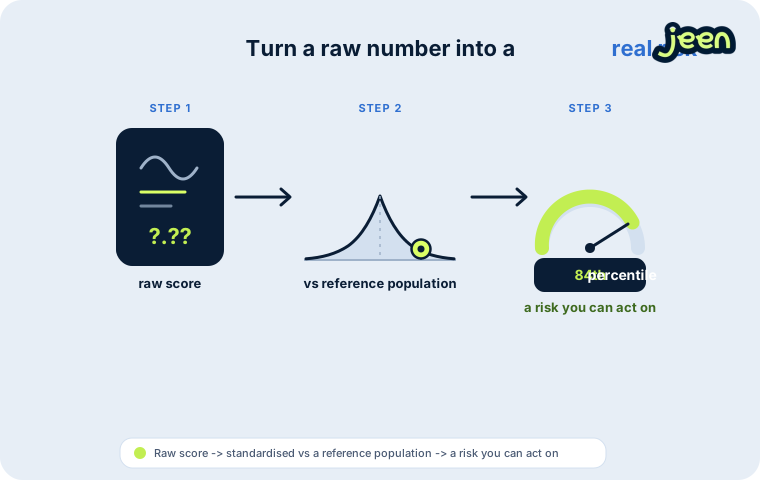
Diagram of a raw polygenic score standardised against a reference population and calibrated to a risk

Normalise and calibrate

Turning A Raw Number Into A Risk

A raw score means little on its own, so it is centred and standardised against a reference population - often as a percentile. Calibration then checks the numbers are trustworthy: if a group is told their risk is 30%, then roughly 30 in 100 should go on to develop the condition over the relevant time period. This step needs accurate, population-specific data.

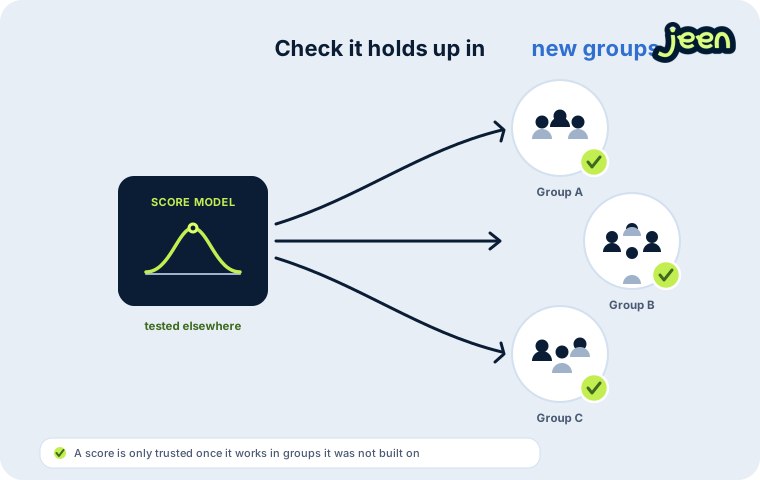
Diagram of a polygenic risk score validated in independent population groups

Validate in independent groups

Proving It Works Beyond The Training Data

A score that looks excellent in the data used to build it can disappoint elsewhere. That is why a good PRS is tested in separate, independent groups of people. Validation guards against overfitting and confirms the score still performs in the population where it will actually be used - including across different ancestries.

Illustration of a genetic counsellor explaining a polygenic risk score result to a patient

Report it back to you

A Score You Can Actually Use

Finally, the validated, calibrated score is reported in a way you can understand and act on - usually as a percentile and, where possible, an estimate of your absolute risk over time. Our team then helps you read it in the context of your wider health.

Interactive explainer

See how a condition's rarity and a test's sensitivity, specificity and predictive value shape what a result really means.

Inside the pipeline, step by step

How prevalence, sensitivity and specificity shape test accuracy

Without condition
With condition
Test cutoff
Sensitivity
—
TP / (TP + FN)
Specificity
—
TN / (TN + FP)
PPV
—
TP / (TP + FP)
NPV
—
TN / (TN + FN)
Condition prevalence 1:10,000
1:100 1:1k 1:10k 1:100k 1:1M 1:10M
Test sensitivity 99.0%
Test specificity 99.5%

What happens at each stage

Sensitivity — of people who have the condition, the proportion who test positive.

Specificity — of people without the condition, the proportion who test negative.

PPV — if a test is positive, the probability the person actually has the condition.

NPV — if a test is negative, the probability the person actually does not have the condition.

Try this: keep sensitivity and specificity at 99% and drag prevalence from 1:100 down to 1:10M. Watch PPV collapse — the rarer the condition, the less a positive result actually means.

What your result means

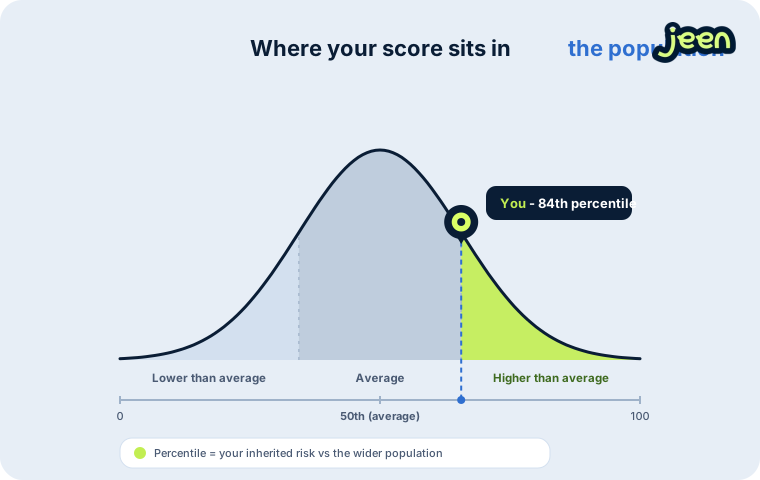
Your polygenic risk score is reported as a percentile, a relative risk and, where possible, an absolute risk over time. Think of it like an exam marked on a curve: the raw mark matters less than where you sit relative to everyone else. Read alongside your test statistics, it becomes a number you can act on.

Illustration showing a polygenic risk score percentile on a curve compared with a reference population

Why A High Score Isn't A Diagnosis

A high score means higher-than-average inherited risk, not a diagnosis. Lifestyle, environment, ancestry and plain chance all matter, so many high-score people never develop the condition.

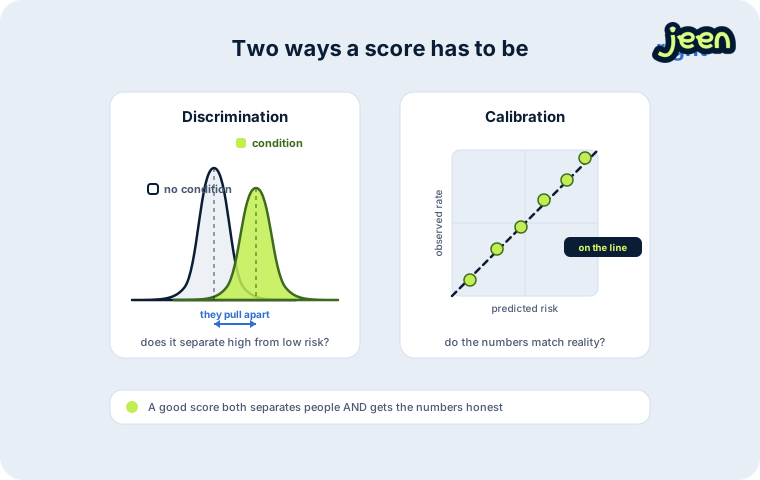
Illustration comparing how well a polygenic risk score separates people and matches real event rates

Discrimination vs Calibration

A good score does two jobs: discrimination (separating people who go on to develop the condition from those who do not) and calibration (its risk numbers matching real-world event rates).

Illustration of how a polygenic risk score supports earlier screening and prevention decisions

Where PRS Helps In Practice

A PRS can support earlier or more frequent screening, guide prevention such as lifestyle changes, and inform shared decisions when standard risk tools leave things uncertain.

Why Jeen?

Not every polygenic risk score is built the same way. Jeen's Polygenic Risk Score Test is designed to give you a clear, ancestry-aware result you can act on. Here's what sets it apart:

Ancestry-specific analysis for fairer results

Risk across 20+ common conditions

One home saliva sample, expert support

What Now?

Have questions? We're here to help. A polygenic risk score can feel overwhelming, but it doesn't have to be. Our genetic counsellors will walk you through your genetic disease risk options, explain the science in plain English, and help you decide if the Polygenic Risk Score Test is right for you.

Polygenic Risk
Score Test

Get started

Frequently Asked Questions

Is a polygenic risk score a diagnosis?

No. A polygenic risk score estimates your inherited susceptibility to a condition by summing many small common-variant effects. It tells you whether your inherited risk is below average, around average or above average - it does not tell you whether you have, or will get, the condition.

How accurate is a polygenic risk score?

A well-built PRS that has been validated in independent groups can meaningfully separate higher-risk from lower-risk people. Its accuracy depends on the size and diversity of the underlying studies and on how well it transfers to your ancestry. It is most powerful when combined with your age, sex, family history and clinical factors.

Can my polygenic risk score change over time?

Your DNA does not change, so the genetic part of your score stays the same. What can change is the science behind it: as larger, more diverse studies are published and methods improve, a score may be recalculated. Your overall risk picture can also shift as your age, lifestyle and clinical factors change.

Does a high score mean I will get the disease?

No. A high score means your inherited risk is above average, not that the outcome is fixed. Many people with a high score never develop the condition, because lifestyle, environment, healthcare and chance all play a part. A high score is best seen as a prompt to focus on prevention and screening.

How is a PRS different from a BRCA test?

A BRCA test looks for a single rare, high-impact change that can sharply raise risk on its own. A polygenic risk score instead adds up many common variants, each with a tiny effect. They answer different questions and, when appropriate, can be used together for a fuller picture.

Should I speak to a genetic counsellor about my score?

Yes, and it is a key part of your journey with Jeen. A polygenic risk score is most useful when read in context. Our genetic counsellors and clinical geneticists help you understand what your result means for you and your family and what sensible next steps look like.

What conditions can a polygenic risk score cover?

Polygenic risk scores work best for common, polygenic conditions where risk is spread across many variants - for example coronary artery disease, type 2 diabetes, and breast or prostate cancer. Jeen's Polygenic Risk Score Test reports risk across 20+ common conditions, which you can explore on our genetic disease risk page.

Why does ancestry matter for a polygenic risk score?

Many polygenic risk scores were built mainly from people of European ancestry, so they can transfer less well to other groups. Jeen uses ancestry-specific analysis so your score is compared with an appropriate reference population. If you are unsure how this affects you, the NHS guide to genetic testing is a helpful starting point, and our team can talk it through with you.

Book your appointment

Choose a time that suits you - no account needed.

Trouble loading? Open the booking page.

Contact

Get in touch

Our team of expert specialists is here to help - whether you're curious about testing, your results, or what's right for you. We're just a message away.

Contact details

  • my@jeen.health
  • +44 20 3870 9099
  • WhatsApp us
  • 36 Spital Square, London E1 6DY
Book a consultation
Which test(s) are you interested in? (optional)

Reproductive & Newborn

Prenatal Testing (NIPT)

Hereditary Cancer Screening

Disease Panels

Or email us directly at my@jeen.health - we reply within one working day.

Jeen Health

Advanced private genetic testing - hereditary cancer, NIPT and carrier screening - with expert genetic counselling at every step.

In partnership with London Pregnancy Clinic & Spital Clinic.

Tests

  • Hereditary Cancer
  • NIPT Screening
  • Carrier Screening
  • Karyotype
  • Newborn Screening

Company

  • Our Mission
  • What are Genetics?
  • Library
  • Blog
  • Fees

Support

  • Genetic Counselling
  • Understanding Statistics
  • Partners
  • Book Now

Contact

  • my@jeen.health
  • +44 20 3870 9099
  • WhatsApp us
  • 36 Spital Square, London E1 6DY

© 2026 Jeen Health. All rights reserved.

Privacy Policy Terms & Conditions Return Policy