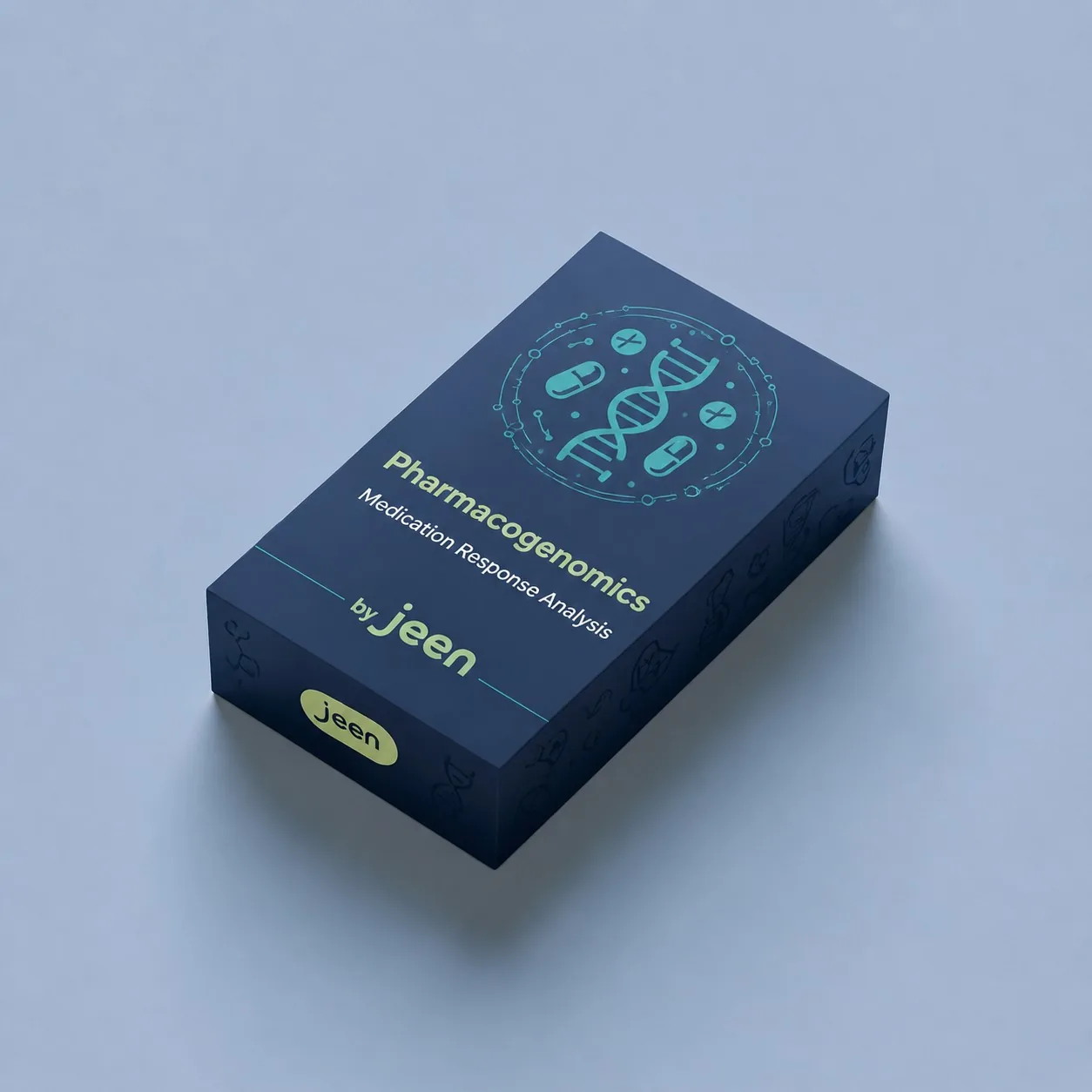




Medication Check + Genetic Disease Risk
Medication Check and Genetic Disease Risk from one saliva kit.
- Results in
- About 4 weeks
- Sample
- Saliva Test
- Save £90 - £419 vs £509 ordered separately
- Pharmacogenomic medication-response test + Polygenic Risk Score across 20+ conditions
- One home saliva kit covers both tests
- Results to your secure Jeen dashboard
Klarna’s credit agreements are not regulated by the FCA. Use of these and any missed payments may affect your ability to obtain credit from Klarna and other lenders. 18+, UK residents only. Subject to status. T&Cs apply. Klarna terms apply.
How it works
Talk to a clinician
Your kit is posted to you after you order. We recommend booking a pre-test consultation with one of our clinicians, using the link in your order confirmation.
Consent + collect
Complete your consent form online, collect your sample at home, and post it back in the pre-paid envelope.
Results + follow-up
We email you when your results are ready, with a link to book a follow-up consultation to go through them.
Is it right for you?
Who this test is for, in plain words.
Suitable if
This test is for adults aged 18 and over. No GP referral is needed, and a polygenic risk score estimates inherited risk - it is not a diagnosis.
Good to know
Delivery, the sample and the small print, in plain words.
Delivery and returns
1. Your kit is posted to you. Free delivery of your kit. Kits are currently sold out: new stock is due in mid-November 2026, and advance orders are posted as soon as it arrives. You don't have to wait for a consultation first - your order confirmation includes a link to book a pre-test consultation with one of our clinicians, which we recommend. Changed your mind? Return the kit unused within 30 days at no charge.
2. Return and results. Collect your sample at home using the instructions in your kit and post it back in the pre-paid envelope. Turnaround is counted from when your sample reaches the laboratory.
- Turnaround
- About 4 weeks
How the sample is taken
Saliva kit : Saliva collection kit, sent to your home.
Two DNA insights, one saliva kit
This bundle pairs our two adult health-optimisation DNA tests at a single discounted price:
- Medication Check (Pharmacogenomics) - reads the genes that control how you absorb, activate and clear common prescription medicines, so your clinician can pick the right drug and dose first time and avoid predictable side-effects.
- Genetic Disease Risk (Polygenic Risk Score) - adds up large numbers of common DNA variants into ancestry-specific risk scores across more than 20 conditions, including coronary heart disease, breast cancer, prostate cancer, type 2 diabetes and Alzheimer's disease. The exact set scored depends on your sex - see the Polygenic Risk Score page for the full list.
Both run from the same home saliva sample, reported to your secure Jeen dashboard.
How the discount works
| Standalone | Bundle | You save | |
|---|---|---|---|
| PgX + PRS | £509 (£210 + £299) | £419 | £90 |
Important
Your polygenic risk score estimates inherited risk only - it is not a diagnosis and does not replace NHS screening. The pharmacogenomic report is decision-support information for you and your prescriber, not a directive to start or stop any medication. If you only need one of the two, the standalone Medication Check and Genetic Disease Risk pages give the full per-test detail.
Compare with similar tests
Medication Check
£210
Results in about 4 weeks
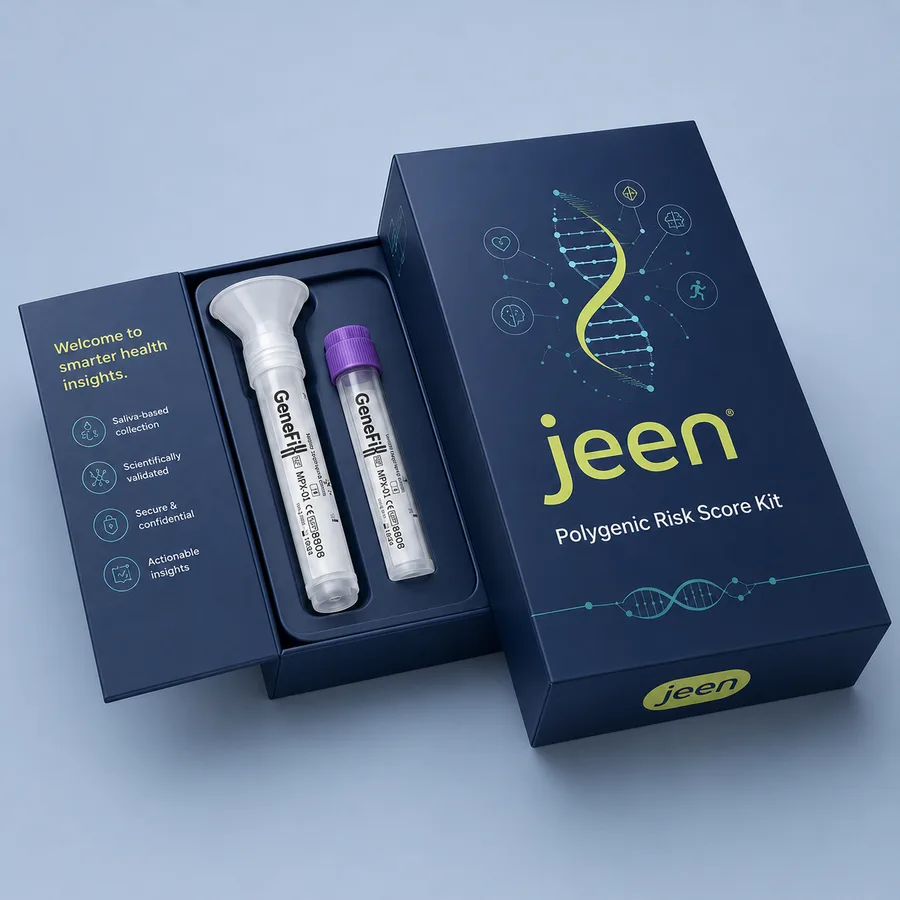 Genetic Disease Risk
£299
Results in about 4 weeks · 21 conditions
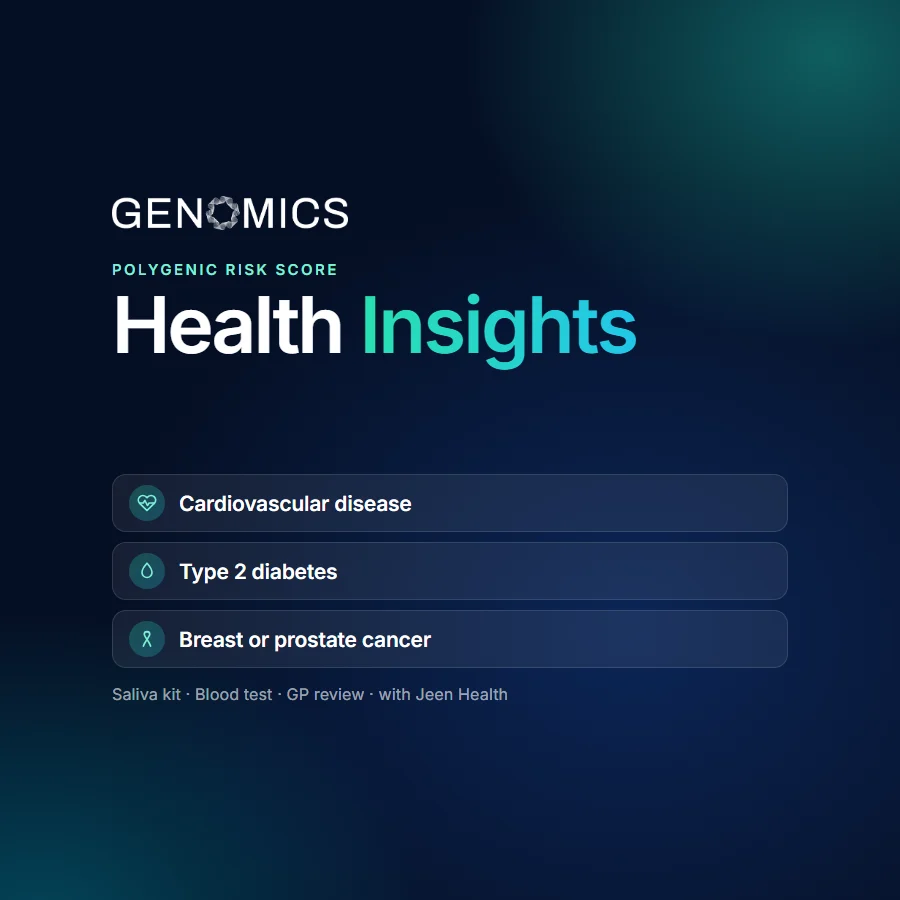 Genomics Health Insights
£399
Results in 4–6 weeks · 4 conditions
Medication Check + Genetic Disease Risk
£419
Results in about 4 weeks
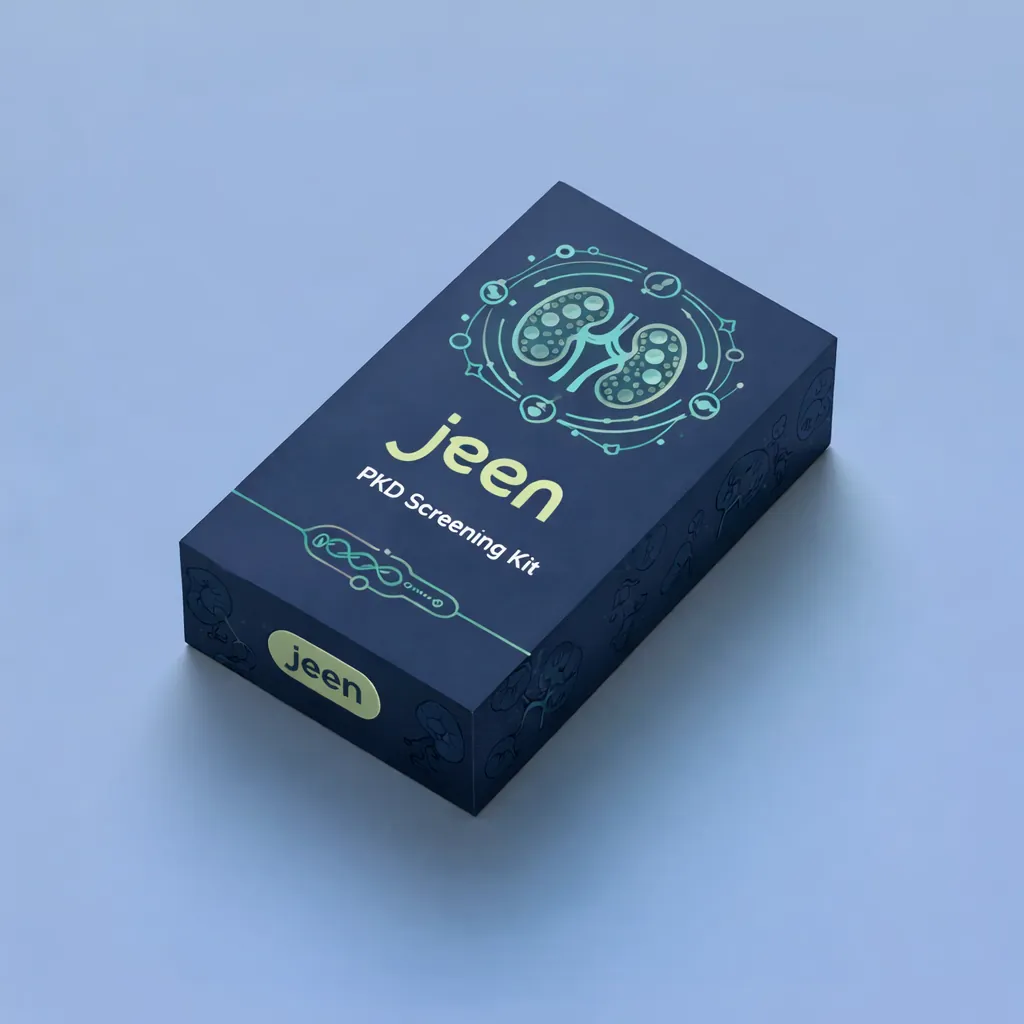 Polycystic Kidney Disease (PKD)
£930
Results in 4–6 weeks
Common questions
What does the PgX + PRS bundle include?
Two tests from one home saliva sample: the Pharmacogenomic Medication Check, which reads how your genes affect your response to common prescription medicines (helping your clinician choose the right drug and dose), and the Polygenic Risk Score, which estimates your inherited risk across more than 20 conditions, including coronary heart disease, breast cancer, prostate cancer, type 2 diabetes and Alzheimer's disease. The bundle is £419 - a £90 saving versus the £210 Medication Check and £299 Genetic Disease Risk test ordered separately.
How is the sample collected and how long do results take?
Both tests run from a single saliva sample you collect at home with the kit we post you - no blood draw or clinic visit needed. Results are returned to your secure Jeen dashboard, typically within about four weeks. We'll email you when each is available.
Is the Polygenic Risk Score a diagnosis?
No. A polygenic risk score estimates inherited risk relative to the wider population - it sits alongside your age, family history, lifestyle and routine clinical checks, and is not a diagnosis or a substitute for NHS screening. Likewise, the pharmacogenomic result is decision-support information for you and your prescriber; never start, stop or change a medication on the basis of the report without speaking to your doctor or pharmacist.
What is a pharmacogenomic test?
Pharmacogenomics looks at how your genes affect the way your body responds to medicines. Small differences in your drug-metabolising genes can mean a standard dose is too strong, too weak, or more likely to cause side effects for you. A one-off test reads those genes so prescribing can be tailored to you - not the average patient. Around 5–10% of people of European ancestry are CYP2D6 “poor metabolisers”, for example - your report places you in one of four clear categories (poor, intermediate, normal, or rapid/ultra-rapid).
What does pharmacogenomics actually measure?
Pharmacogenomic testing focuses on a small set of genes that code for drug-metabolising enzymes (mostly the cytochrome P450 family - CYP2D6, CYP2C19, CYP2C9, CYP3A4/5), drug transporters (SLCO1B1), and drug targets (e.g. VKORC1 for warfarin, HLA-B for several immunology and HIV drugs). Variants in these genes group people into four broad metaboliser phenotypes:
- Poor metaboliser - the drug builds up in your body; standard doses cause side effects.
- Intermediate metaboliser - slower-than-average; you may need a lower dose.
- Normal metaboliser - standard dosing works as designed.
- Rapid / ultra-rapid metaboliser - the drug clears too quickly to be effective at the usual dose; you may need a higher dose, or a different drug.
Conversely, ultra-rapid CYP2D6 metabolisers convert codeine to morphine so quickly that standard doses can become dangerous. A simple saliva test tells you which group you’re in before a clinical decision needs to be made.
Which medications does the test cover?
The test screens 112+ medications across 14 therapy areas, focusing on the drugs where genetics most affects safety and effectiveness. These include antidepressants and antipsychotics, painkillers such as codeine and tramadol, heart medicines such as warfarin and clopidogrel, statins and several cancer therapies. It reads the key genes for drug response, including CYP2D6, CYP2C19, CYP2C9, CYP3A4/5, SLCO1B1, VKORC1, DPYD and TPMT.
Do I need to stop my current medication before the test?
No. Take your prescribed medication exactly as your doctor recommended - your current prescriptions do not affect the result. Pharmacogenomic testing reads your DNA, not the drugs in your bloodstream.
Can the test results change over time?
No - your DNA stays the same throughout your life, so the variants we report are stable. The interpretation, however, can evolve as new pharmacogenomic evidence is published. Your report reflects the latest CPIC and DPWG guidelines on the date it was issued. If your prescription situation changes substantially, ask your doctor to review the report alongside the most current guidelines.
Do I have to share the results with my GP?
It’s optional, but we strongly recommend it. The whole point of the test is to inform future prescribing decisions, so showing the report to whoever prescribes for you (NHS GP, private GP, specialist) is the practical use case. The 30-minute appointment with our own GPs is included so a clinician can help you interpret anything flagged.
Will my health insurer get access to my results?
No. We do not share genetic-test results with UK health insurers. If you live or move outside the UK, local laws may require you to disclose genetic-test results to your insurer - that’s outside our control.
Are all the scores equally reliable?
No - and we’d rather be upfront about that. Polygenic scoring is more strongly validated for some conditions (such as coronary artery disease, breast cancer, type 2 diabetes and lipoprotein(a)) than for others, and accuracy also varies with your genetic ancestry. Each score is best read as one input alongside your age, family history, lifestyle and clinical measurements - not as a standalone verdict. Your included genetic-counselling session can explain how much weight to give each result.
Not sure? Ask a person.
Tell a genetic counsellor what you are worried about and they will point you to the right test, or tell you if you do not need one.