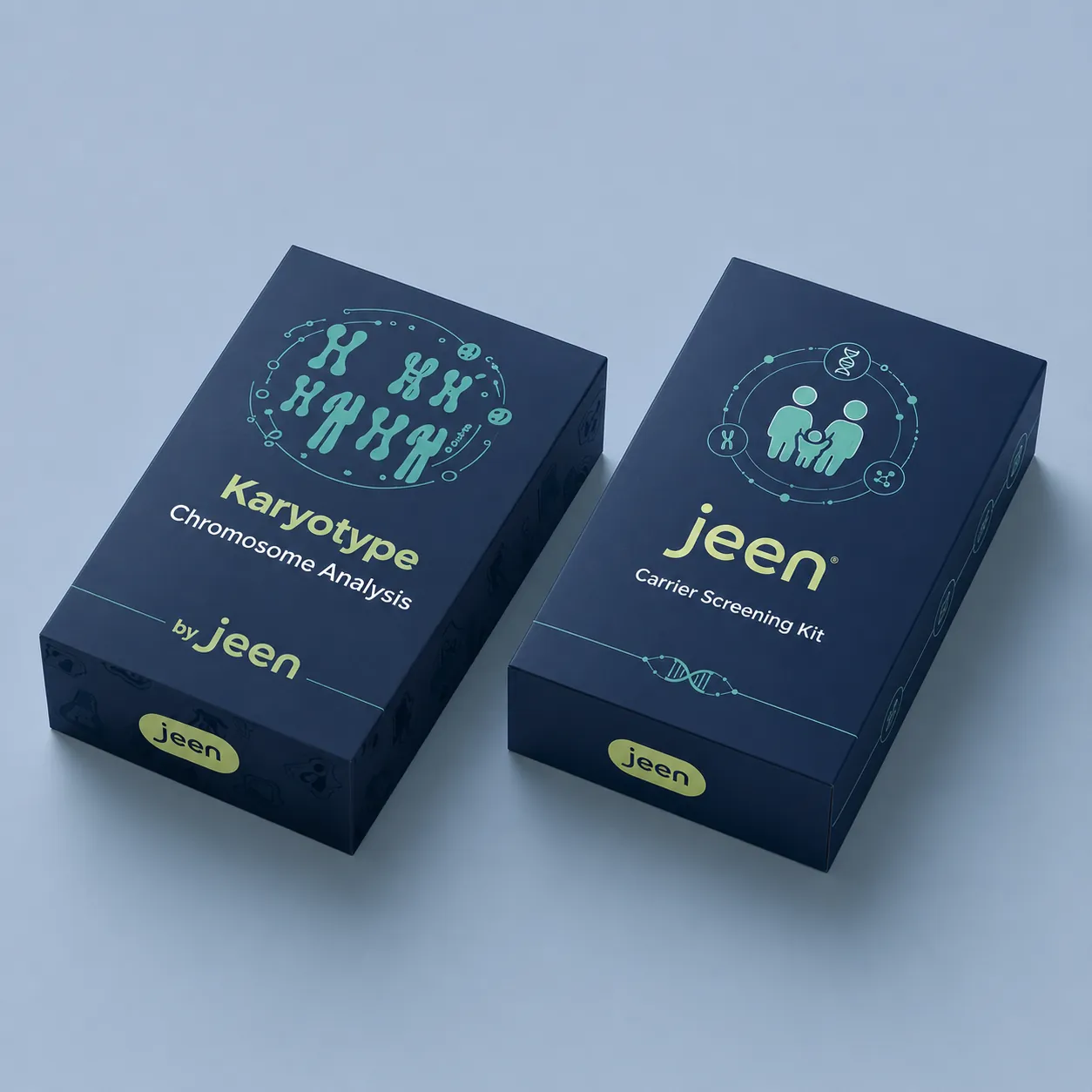




Carrier Screening + Karyotype
Carrier screening and chromosome analysis together: one counselling session, one blood draw, one report.
- Results in
- 17–21 working days
- Save £80 (single) or £130 (couple) vs ordering separately
- 30-minute specialist genetic counselling included - covers both tests
- 1,008-gene carrier panel + chromosome-level karyotype analysis
- One blood draw, one integrated report
Klarna’s credit agreements are not regulated by the FCA. Use of these and any missed payments may affect your ability to obtain credit from Klarna and other lenders. 18+, UK residents only. Subject to status. T&Cs apply. Klarna terms apply.
How it works
Talk to a clinician
Book your included 30-minute consultation with our genetic counsellor (video or phone). Confirm the test that's right for you.
Consent + collect
Complete your consent form online, receive your kit, and collect your sample at home or via a clinic of your choice.
Results + follow-up
Your results are reviewed by your genetic counsellor. We share them with you securely, and book a follow-up consultation with onward referrals if your result is high-risk.
Is it right for you?
Who this test is for, in plain words.
Suitable if
Genetic testing with Jeen Health is suitable for adults who have completed a pre-test consultation with one of our genetic counsellors - in clinic, over video, or by phone.
Genetic testing with Jeen Health is only available to individuals aged 18 and over.
Good to know
Delivery, the sample and the small print, in plain words.
Delivery and returns
1. Get your kit from us. Free delivery of your test kit, dispatched 1–2 working days after your included 30-minute genetic counsellor consultation (video or phone) and your signed consent form, by next-day delivery. Changed your mind? Return the kit unused within 30 days at no charge.
2. Posting your sample back. After sample collection, send your sample in the pre-paid bag to the nearest depot (details in your email). Turnaround is counted in working days from when your sample reaches the laboratory.
- Turnaround
- 17–21 working days
How the sample is taken
Blood draw : Standard venous blood draw, performed at a clinic or by a mobile phlebotomist.
Where you can have blood taken
200+ partner clinics across the UK. If you choose a clinic blood draw, you pick the one nearest to you. Find your nearest clinic.
Your kit comes first. Our partner clinics do not keep test kits. We post your kit to you after your consultation: book your blood draw only once it has arrived, and take it with you.
London Pregnancy Clinic, no extra fee. Local to London? Have your blood taken at our own clinic, at no extra cost: choose “Arrange your own” when you order. (36 Spital Square, London E1 6DY)
The complete pre-conception work-up
Couples planning a pregnancy often want answers to two distinct genetic questions:
- "What recessive conditions could we pass on?" - answered by Carrier Screening (1,008-gene panel).
- "Could a balanced chromosomal rearrangement be behind unexplained miscarriage or fertility issues?" - answered by Karyotype Chromosome Analysis.
We've bundled them at a meaningful discount, with one counselling session, one blood draw, and one integrated results conversation.
How the discount works
| Standalone | Bundle | You save | |
|---|---|---|---|
| Single | £930 (£660 + £270) | £850 | £80 |
| Couple | £1,720 (£1,200 + £520) | £1,590 | £130 |
Bundling the two tests means one counselling appointment, one blood draw, and one integrated report - materially cheaper to run for us, and we pass the saving on.
What's included
- Carrier Screening - 1,008-gene panel covering metabolic, neuromuscular, neurological, sensory, immunodeficiency, kidney, cancer-predisposition and other recessive / X-linked categories.
- Karyotype Chromosome Analysis - cytogenetic G-banding of all 46 chromosomes. Detects numerical changes (trisomies, monosomies) and large structural rearrangements (translocations, inversions, deletions).
- 30-minute pre-test consultation included with our specialist genetic counsellor - covers both tests' implications, family history, and what each result type means in practice. Same session, not two.
- One sample collection - the same blood draw covers both tests (separate tubes; same appointment).
- Integrated clinical report - both panels' findings synthesised into a single results document and shared via your secure dashboard.
- High-risk follow-up consultation booked if either panel returns a clinically-actionable finding.
Who should consider this bundle
- Couples planning a pregnancy who want both checks in one order.
- Anyone investigating recurrent miscarriage (≥ 2 first-trimester losses) or unexplained infertility - the karyotype can detect balanced rearrangements that hormone panels miss, while the carrier panel checks for a recessive overlap.
- Couples with a known family history involving either a recessive condition OR a balanced translocation.
- Patients who'd otherwise pay for both separately and want the cleaner journey.
If you only need ONE of the two, the standalone Carrier Screening and Karyotype Chromosome Analysis pages give the full per-test detail.
Compare with similar tests
 Sperm Analysis in London
£220
Results in 2–3 working days
 Karyotype Chromosome Analysis
£270
Results in 10–14 working days
 Carrier Screening
£660
Results in 17–21 working days · 1,008 genes
 SMA Newborn Testing
£690
Results in 3–4 weeks · 2 genes
 Newborn Genetic Screening
£720
Results in 3–4 weeks · 258 genes
Carrier Screening + Karyotype
£850
Results in 17–21 working days
CGT: Igenomix Carrier Genetic Test
£990
Results in 25 working days
Common questions
How much does the Carrier + Karyotype bundle cost?
The bundle starts at £850 for a single person and £1,590 for a couple - a saving of £80 and £130 respectively vs ordering Carrier Screening (£660 / £1,200) and Karyotype Chromosome Analysis (£270 / £520) separately. Both options include a 30-minute pre-test consultation with our specialist genetic counsellor, lab analysis at our partner laboratories, and an integrated clinical-grade report. Add a blood draw at one of our 200+ collection points (+£20 for one person, +£30 for a couple) or a home-nurse visit (+£60 for one person, +£110 for a couple).
Why bundle Carrier Screening and Karyotype together?
Both tests answer different questions about the same reproductive risk picture. Carrier screening tells you which recessive conditions you and your partner each carry - useful for planning whether IVF with PGT-M, donor selection, or early prenatal monitoring is worth considering. Karyotype tells you whether a balanced chromosomal rearrangement (most commonly translocations) is contributing to recurrent miscarriage or unexplained infertility. The bundle saves cost and consolidates the clinical pathway into one counselling session, one blood draw, and one integrated report.
How is the sample collected?
One blood draw covers both tests - separate vacutainer tubes, same appointment. You can arrange your own draw (for example with your GP or a local phlebotomy service) with no extra charge from Jeen, though that provider may charge its own fee; use any of our 200+ collection points (+£20 for one person, +£30 for a couple); or book a home-nurse visit (+£60 for one person, +£110 for a couple). Couples bring both partners to the same appointment.
How long do results take?
Results take 17–21 working days from when the lab receives your sample. We hold both results and share them together in a single integrated report once both labs have reported. Your genetic counsellor reviews every report; we book a follow-up consultation if either panel returns a high-risk finding.
Do I need a GP referral?
No. Anyone aged 18+ can book directly with Jeen Health, with no GP referral. After you order we email you a link to book your included 30-minute pre-test consultation with a genetic counsellor, who will walk you through both tests' implications before you commit to the draw. Your kit and draw-request paperwork are dispatched 1–2 working days after that consultation and your signed consent form, by next-day delivery.
What can carrier screening not tell me?
Carrier screening is a screening test, not a diagnosis. No panel detects every variant in every gene, so a negative result lowers but does not remove the chance that you are a carrier. It cannot tell you whether a pregnancy will be healthy, and what a result means for a pregnancy depends on the gene, how it is inherited and, for many conditions, whether your partner is also a carrier.
What are the limits of a karyotype test?
A karyotype looks at the number and structure of your chromosomes under a microscope, so it only sees changes larger than about 5–10 million base pairs. It cannot detect smaller deletions or duplications, single-gene variants or most other causes of miscarriage or infertility, so a normal result does not rule out a genetic cause. It needs cells that grow in the laboratory; if they do not, we arrange a free redraw. It analyses the chromosomes in your own blood sample and is not a test of a pregnancy - if you are pregnant, your midwife or fetal medicine team can explain options such as NIPT, CVS and amniocentesis.
Do both partners need to get tested?
It’s ideal for both partners to be tested, but we usually start by testing one. If that person is not a carrier, no further testing is needed. If they are, then their partner should be tested to check for the same condition. This step-by-step approach helps keep testing straightforward and cost-effective. Our team will guide you based on the results and help you understand your reproductive risks together.
Can I have carrier screening if I’m already pregnant?
Mostly yes, you can have carrier screening during pregnancy - depending on how far along you are. Ideally, carrier screening is done before conception so you have more time and options, but it’s still valuable if you’re already pregnant. If you’re found to be a carrier during pregnancy, we may recommend testing your partner too. If both partners carry the same gene variant, there’s a 1 in 4 (25%) chance the baby could inherit the condition. Our genetic counsellors will support you through the next steps.
What happens if I’m found to be a carrier?
If you’re found to be a carrier, it means you have one copy of a gene variant linked to a particular condition. Carriers usually do not have symptoms, but if your partner is also a carrier for the same condition, there may be a chance of passing the condition on to your child (depending on the inheritance pattern). Our genetic counsellors will explain your results and what they mean for you. Depending on your partner’s results and your family plans, next steps may include partner testing, discussing reproductive options, or simply keeping this information in mind for future pregnancies. In some situations, such as complex results, a strong family history, or higher-risk findings, you may also be advised to speak with a clinical geneticist for more detailed medical guidance.
What are X-linked conditions?
X-linked conditions are genetic disorders caused by changes in genes found on the X chromosome, one of the two sex chromosomes. Since males only have one X chromosome (and one Y), if they inherit a gene variant on the X chromosome, they’re more likely to be affected by the condition. Females have two X chromosomes, so if one carries a faulty gene, the other can often compensate, which means women are usually carriers without symptoms. Some common X-linked conditions include Duchenne muscular dystrophy and fragile X syndrome. If you’re a female carrier of an X-linked condition, there’s a 50% chance of passing the gene to each child. Sons who inherit it are more likely to be affected, while daughters may become carriers like you.
What is a balanced translocation?
A balanced translocation occurs when a segment of one chromosome breaks off and attaches to another chromosome. Because no genetic material is gained or lost, the carrier is usually completely healthy and unaware of the rearrangement. However, when a carrier of a balanced translocation tries to conceive, their eggs or sperm may end up with an unbalanced amount of chromosomal material. This can lead to recurrent miscarriage, failed implantation, or in some cases a pregnancy affected by a chromosomal condition. Identifying a balanced translocation through karyotype testing is a crucial step in understanding and managing recurrent pregnancy loss.
Is karyotype testing available on the NHS?
Karyotype testing is sometimes available on the NHS, but access can vary by region and waiting times can be lengthy. Many NHS pathways require a referral from a specialist and may only be offered after a set number of miscarriages or failed IVF cycles. Through Jeen Health, you can access karyotype testing privately without a GP referral, with genetic counselling available on request and results in 2 to 3 weeks. Testing is available at our London clinic, at 200+ partner clinics across the UK or with a nurse at your home, making it a convenient option if you prefer not to wait.
Not sure? Ask a person.
Tell a genetic counsellor what you are worried about and they will point you to the right test, or tell you if you do not need one.